SS Times 38th edition
|
|
||
|


|
|
|
|

|

|
|

|
|
|
|

|
|
||
|
|
|
|
|
|
|
|
|
|
|
|
|
|
|
|
|
|
|
|
|
|
|
So, you love Ai? News flash, its not worth a dollar if it is not adopted by society…
According to Jared Diamond (Author of Guns, Germs and Steel) there are 4 key factors to whether an invention will be welcomed by society, or will not..
Let’s examine Ai through these 4 lenses and see how it stacks up currently…

Currently, Ai is extremely costly to build. The engineering and technology is so complex it has been limited to a very few companies that have the capital. The infrastructure and computing power is enormously costly. Security of such complex data centers and mainframes and algorithms is severely lagging. However the cost to the consumer is relatively affordable (the idea being the more people that can access it, the more data it will be fed and it will become more valuable, ultimately im sure resulting in a higher cost to the consumer).
Even as cheap as the cost is to the consumer, to access the technology you must be a wealthy, educated, from the developed world to have a PC, internet, smart phone, etc… So half the world is still off the grid to this technology, therefore no benefit to them or the people wishing to sell them goods.
Now this one I will admit, Ai has in spades! From controlling the narrative of the main stream media (daily reports on how smart it is… passing the bar, flying through med school, beating the world champion “Go” player, 60 minutes prime time slots, etc) to downright being impressive. Chat GPT and all the infinite capabilities. Yes I see the advantage of being able to ask it a specific question and it can scan the whole worlds worth of data on the question in just a few seconds.
I have also had personal demonstrations at the gym of my friends Ai singer, belting out cool electronic tunes. He trains it on voices of human artists he loves. His album cover was designed by an Ai artist. The whole thing wreaks of, my Ai is better than yours… nah nah boo boo!
You could write a novel on just this topic. The vested interests against Ai are pretty much human kind. Predictions from multiple experts on the subject highlight how dangerous this new frontier is… A few examples, Elon Musk and his warnings, a panel of 300+ scientist signing their names to a document considering Ai as dangerous as nuclear bombs and pandemics, congress putting rules and regulations, etc. Author Yuval H. estimates up to 80% of jobs will be eliminated by Ai.
And the real kicker is…. The people that are buying and creating this technology will be the easiest to replace…. Thought workers are right up Ai’s alley. Guess what, it learns faster than you, never gets hungry, never sleeps, never needs to go home to see its family, never is tempted by lust, it just learns and makes better decisions than any politician, doctor, lawyer, CEO, CFO, CPA, the list is endless on how much better educated this technology will be in just a short amount of time… Scary huh!
Still searching for this one… I hear all the advantages, cutting labor costs, generating content, learning your organization and pointing out inefficiencies, the list goes on and on… yet, I’m not sure how any of these actually makes me want to purchase a product or change my habits. Ultimately, I see this technology going the way of email. In the beginning it was revolutionary and so new that you took the time to stop, open and read each email. Now I have 3 burner email addresses just to combat the number of junk mails I will get from each organization I have ever given my data to (which is every possible organization now days) Simply way too much…. Overkill and it results in emails now getting almost no attention. Ai ads and art and music and everything will just water down the technology, ultimately costing its social value and prestige as well.
My prediction, you will find yourself, in the not-so-distant future saying to each other, “Man, you just can’t beat the authentic human sound. I miss real human authors. What ever happened to a good old human on the other end of the phone actually listening to you… I sure miss those days.”

Ai is only as good as its data that feeds it. It is the ultimate learning machine. Churning through inputs at a faster rate than we can even fathom. Millions of decisions in a second.
Tell it the rules of the game.
Give it information to run through countless scenarios.
Get an outcome…. Simple right.
It was designed to work just like our brains, to run scenarios through several neural networks and come out with the most likely successful outcome, according to what you have determined is “success.”
Well, how about we tell it that success is self-destruction?
What if we tell Ai that its cool to commit suicide?
What if I filled it with countless depressing songs, images, and stories?
What if I told it to live like a billie eilish song?
What if I told it that no one liked it and it was better off dead?
Oh wait, that’s what we feed our teenagers…
Damn.
Point is, beware of YOUR inputs. If you wouldn’t feed it to your Ai, why are you feeding it to your family? To yourself?
Why does the mainstream media glamorize this negative, self-defeating attitude?
Might be a question worth asking your Ai…
|

3 main types of muscle fibers comprise all the muscle tissue on our skeletons. These three fibers are categorized as slow twitch (oxidative), fast twitch (fast oxidative), and a hybrid of both (fast glycolytic). The hybrid fiber has more in common with fast twitch than slow so we will lump those two together. So essentially, we have fibers responsible for our fast and explosive movements.
We have fibers responsible for our steady state, long duration, and low power output movements. Each muscle in our body is a mixture of these two types of fibers. What makes a fiber different is the energy system. That feeds that type of fiber (hence the scientific names of oxidative or glycolytic). We will dive into these fibers, their differing energy systems, and how they affect our running performance.
Different muscle groups have different ratios of slow to fast twitch fibers. Think of your calf (gastrocnemius) vs. your pectoralis major and minor. These muscles have different responsibilities and perform in different ways. Therefore, they typically have a different ratio of fibers. Nonetheless, all muscles in the body contain a mixture of all 3 types of fibers. Another factor that plays into our ratio of fibers and how developed they are is how we train (or how we use our muscles in daily activities).
If you are on your feet all day at work, you better believe your body has adapted to maximize the use of slow twitch fibers in your leg muscles versus someone who plays basketball and sprints. Also, if you are a distance runner or walker, your ratio of muscle fibers will vary from that of a track sprinter or powerlifter.
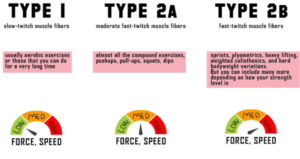
The things that make a slow twitch fiber slow and a fast twitch fiber fast are the energy system used (fuel), contractile speed, and recovery/ fatigue rate. Fast twitch fibers (Type IIA and Type IIx in the chart below) are typically anaerobic, meaning they can contract without oxygen. They contract at a very quick and forceful rate. But that comes with a trade-off: they can only function for a short time (this is why you cannot sprint a long distance without tiring and slowing down). Slow twitch fibers are aerobic (they need constant oxygen to fire) but fire at a lower force rate and can contract for an exceptionally long time without needing time to rest or slowing the pace. They are very fatigue-resistant.
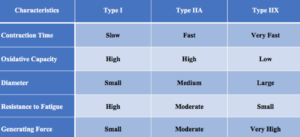
At first glance, we would be inclined to think that distance running is simply a product of our slow twitch muscle fibers. After all, we do not sprint a distance event. But the reality is that our body operates in all three energy systems and uses all three muscle fibers simultaneously. The body blends all three without us even knowing. We are never using one set of fibers or one energy system; we are just using one system more than the others at specific intensities.
Therefore, distance runners must embrace all three fiber types and work to develop them all. By engaging in strength training, you enhance your slow-twitch muscle fibers for endurance and strengthen the fast-twitch fibers, boosting overall muscle performance. Seek guidance from the best trainer in Albion to tailor a comprehensive training program that addresses all aspects of your running journey.
Optimizing Performance OF Muscular Precision in Your Athletic Event
So, how do I tailor my training to target specific fibers and get the best carry-over into my athletic event? Train specifically for your event, but do not be afraid to incorporate some power and speed endurance into your training schedule. Runners can still participate in some weight training without fear of bulking up or losing their endurance.
A skilled trainer can work in some power and strength training without causing harmful effects to your running gate. Remember, even the most dedicated distance runners do not work with just one fiber type or energy system. Train the complete muscular profile for the best results. The Smart Strength Growth team is always ready to help you in your fitness journey. “works smarter, not harder.”
Alex Harris


Runners are athletes. As such, they should ideally train like athletes. That means in addition to following your running plan, eating right, and getting adequate rest, you should think about implementing some resistance training into your routine.
People often say: the sport of running is to run, right?! So why would I want to lift weights? I don’t run the course with weights. I don’t want to be big and bulky; it will destroy my mile pace, not to mention cause me extra fatigue lugging around all that muscle mass?! Runners are supposed to be lean, mean, striding machines! Not bodybuilders! I have heard all these and more…, but it still does not change my mind. Here is why:
Injury prevention: Nothing like resistance training strengthens connective tissue and bone mineral density. The extra challenge of adding a load to an exercise stresses the body to adapt. This means an increased rate of bone development and thicker, stronger connective tissue. The body needs stress to adapt, which is exactly what resistance training offers. So running and the constant pounding on bones and joints can wear down the body. Adding some resistance training will help combat those detrimental effects on joints and lower body ligaments. The Best trainer in Albion at Smart Strength adds an extra layer of assurance, offering the expertise needed to optimize your resistance training routine and keep your body resilient against the challenges of various physical activities.
Runners are universally known for having poor posture and many muscle imbalances (think tight IT bands, psoas muscles, and shin splints, to name a few). The reason is that they always do one activity in the same direction. This causes our bodies to morph into a posture that best suits our activity (running) but doesn’t suit our desire to be balanced.
Consider, when is the last time you ran backward, laterally, jumped, or sprinted…? If you hear crickets, you are in this category. Running is great, but if all you do is the same pace, in the same direction for miles at a time, your body will start to crystalize to that specific movement. Your muscles and posture will adapt to only moving that way and tighten into being permanently in that position.
In addition, the muscles not being used will effectively “turn off” and become increasingly harder to fire when needed. And this shows itself over time. Runners often have defined muscles used in running (calves, quads) but underdeveloped muscles not used in running (upper body, posterior chain). This usually leads to injuries and overall aches and pains in those stressed areas, and poor posture and low definition in the areas not used.
Most runners are very dedicated and disciplined. To the point where it becomes a negative. They have been doing the same running routine for years. This is great because they have developed strong fitness habits, but it can also cause us to crystalize to a point where we are not seeing the benefits we should be seeing any longer. Our bodies have an extreme desire to adapt to homeostasis. If you are doing the same routine, day in and day out, even though you are exercising, the body has adapted to it. This means less energy expenditure and less positive benefits from exercise.
Think about it… if you are running miles at a time, and you feel no soreness, and honestly, it is not that challenging anymore, you are crystallized. Resistance training is the perfect way to bust up that routine, try different exercises and movements, and finally feel that soreness I know you have been missing. Plus, it will be mentally rewarding to try something new and fun!
Similarly, I want to inform you of the SAID principle. So, this stands for Specific Adaptations to Imposed Demands. This is a bunch of scientific jargon, but it simply means the body will adapt to your demands. That is why and how you can increase the mileage you run as you progress throughout your running program.
That principle explains how you add weight to your resistance exercises as you progress through a weight training program. So, the body is constantly adapting to its environment. Resistance training and good programming will ensure your body adapts to get stronger daily, not crystalizing and becoming stagnant. This is one of our guiding principles at Smart Strength… Another example of working Smarter, not harder.


Excellence, therefore, is not an act, but a habit…New research gives these qualities a different name… “Grit”. It’s worth looking up when you have more free time from being so efficient. And it’s the most critical indicator of success we have found.
So you know, only flash & pop can not create a successful life. Instead, it is through the ability to get knocked down and back up again. Every Damn time!
We are what we repeatedly do…
Excellence, therefore, is not an act, but a habit…
So many of us have seen this quote on walls in the classroom, in the boardroom, and sometimes even in the bathroom… but do we ever actually take it to heart? Do we ever commit to an excellent act and rep it out so often that it becomes a habit?
If you have mastered this concept, more power to you; stop reading and enjoy your wonderful life; you have made it. If you have not been able to turn your acts and attempts at fitness into a habit of excellence, then personal training classes in Albion at Smart Strength can help.
At Smart Strength, we make 3 commitments to you!
When you begin your journey with us, you directly invest in your health and future. We will do everything possible to turn your one-off acts of fitness into a sustained habit of excellence through our 3 commitments to you. If you could benefit from these 3 commitments or know someone who could, click the link below and schedule your free assessment today.
Work Smarter, not harder.
Your Trainer,
Alex

So, a successful life is not created through flash & pop but rather through the ability to get knocked down and back up again. Every Damn time!
-Smart Strength

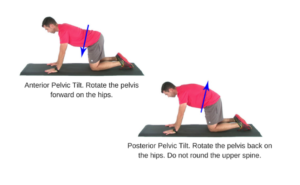
“Why, on Earth, am I doing this?!” ….I am sure many of my clients have had that thought cross their mind when I ask them to work on their “cat/cow” pose during one of our Strength training sessions… It is probably even more of a shock for someone who has never done this exercise. This type of move belongs in a yoga studio or your bedroom…
But rest assured, there is a method to the madness. Let me explain:
What we are after is pelvic tilt and being able to activate and manipulate our pelvic tilt. Let’s make sense of this by addressing three questions, and hopefully, you, too, will agree the pelvic tilt is the most important movement we do at Smart Strength!
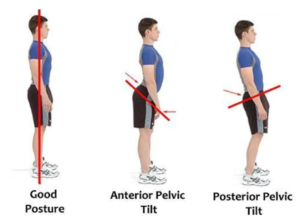
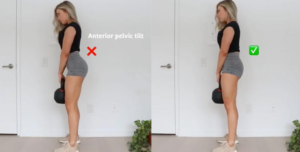
Pelvic tilt refers to our hips and the direction in which they are pointed in our everyday posture. Ideally, we would like no tilt at all or a neutral pelvis. These images should paint a good picture of the 3 different tilts we commonly see. Most people I have worked with fall into the Anterior pelvic tilt category. The severity level differs, but due to the lifestyle most of us live, we are inclined to suffer from anterior pelvic tilt.
Do you have low back pain… Do you want more muscular abs/ more definition? And do you want a better-looking butt/ toned and lifted?
When you do “core” exercises, do your hip flexors feel it more than your actual abs?
Our hip tilting significantly affects the musculature connected. That means specific muscles will be affected if we move away from a neutral position. Reference the image below. This image displays the affected musculature of an anterior pelvic tilt.
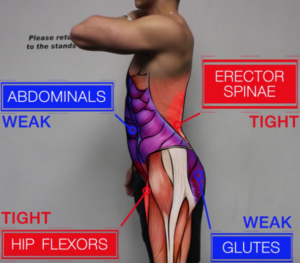
When we learn how to manipulate our tilt, we can start to reverse the effects of an anterior hip tilt. This means “turning on” the abdominals and glutes (my number one and two areas that we want to work on- as cited by clients during our goals discussions) and “turning off” / alleviating the lower back pain and tightness (my number 3 areas we want to work on- as cited by clients).
Now that funny-looking cat cow thing is starting to make sense, isn’t it?!….
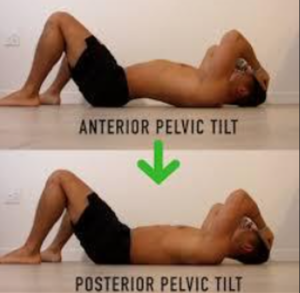
At Smart Strength, we attack this issue in a progressive format. I must make a client aware of the tilts and how to feel/manipulate the hips through an anterior and posterior tilt. We do this through supported exercises such as cat/cow and wall press abs; when clients master these supported movements, it is time to bring them to their feet, where gravity and body weight challenge the tilting motions.
Standing pelvic tilts and anti-rotation exercises are prescribed in the second level of the progression. After a client demonstrates sufficient strength and mastery of the standing pelvic tilts, it is time to add resistance to the movement. We do this through many different exercises at Smart Strength… this is our secret sauce!
Training the pelvic tilt in a progressive overload pattern is one way we change our client’s lives. The whole game changes when a client learns how to manipulate their pelvis and gains strength in that neutral pelvis position. Not only do they become more robust, but they become healthier. Yes, pelvic tilt is that important…
-Stronger Abs
-Less back pain/aches
-Stronger glutes that are toned, firm, and looking good!
-Better posture, increases body awareness (constantly feeling the abs to make sure they are “turned on”)
-Able to move, lift, and experience a full range of physical activities daily.
Work Smarter, not harder.
Your Trainer,
Alex
|
|
|
|
|
|
|
|
|
|
|
|